 workforce news
Since NHS Pharmacy First launched in England in January 2024, millions of consultations have taken place in community pharmacies across the country. The service allows pharmacists to assess and treat seven common conditions — including sore throat, earache, and urinary tract infections — without the patient needing to see a GP first.
Yet despite the programme's rapid uptake, many people are unsure what actually happens when they walk into a pharmacy and ask for help. Is it like a GP appointment? Do you need to book? Will you be seen in private? Can the pharmacist really prescribe medicines?
This guide walks through the process from arrival to treatment.
Before You Arrive
No appointment is needed at most pharmacies. You can walk in during opening hours and ask for a Pharmacy First consultation. Some busier pharmacies may ask you to wait briefly if the pharmacist is dispensing prescriptions, but you will not need to book days in advance.
Bring a list of your current medications if possible. This helps the pharmacist check for interactions before supplying any new medicine. If you have a summary care record accessed via the NHS App, the pharmacist can also view this electronically (with your consent).
You do not need to be registered at the pharmacy. Unlike a GP surgery, you can use any pharmacy — it does not have to be the one where you collect your prescriptions.
The Seven Conditions Covered
Pharmacy First covers the following clinical pathways:
| Condition | Examples |
|---|---|
| Acute sore throat | Painful throat, difficulty swallowing, possible tonsillitis |
| Acute sinusitis | Facial pain, blocked nose, green/yellow discharge |
| Acute otitis media (earache) | Ear pain, fever, reduced hearing (especially in children) |
| Infected insect bites | Bites that are red, swollen, warm, and possibly oozing |
| Impetigo | Crusty, golden sores on the skin (common in children) |
| Shingles | Painful, blistering rash in a band on one side of the body |
| Uncomplicated UTI (women 16–64) | Burning on urination, frequency, urgency |
For conditions outside this list, the pharmacist can still offer advice, sell over-the-counter medicines, and refer you to a GP if needed.
Step by Step: What Happens
Step 1: You Ask for Help
Walk into the pharmacy and tell the counter staff that you would like to see the pharmacist about a health concern. You do not need to describe your symptoms at the counter — simply saying "I'd like a Pharmacy First consultation" is enough.
Step 2: The Private Consultation
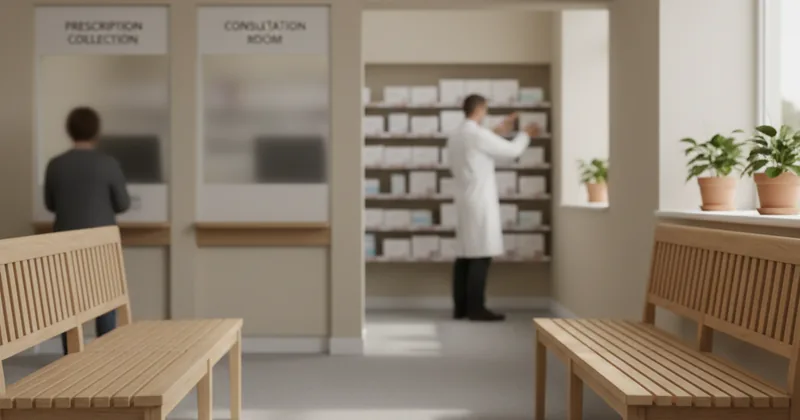
You will be taken to a private consultation room. Every pharmacy that provides NHS services is required to have a consultation area where conversations cannot be overheard. This is the same room used for flu vaccinations, medicine reviews, and other private consultations.
Step 3: The Pharmacist Assesses Your Condition
The pharmacist will:
- Ask about your symptoms — when they started, how they have changed, and what you have tried so far
- Ask about your medical history — any allergies, existing conditions, and current medications
- Examine the affected area if relevant — looking at a rash, checking a throat, or examining an ear (in children, with parental consent)
- Check your summary care record (with your permission) to view your medications and allergies electronically
This part of the consultation typically takes 5–10 minutes.
Step 4: Diagnosis and Treatment Decision
Based on the assessment, the pharmacist will either:
- Recommend self-care — if the condition is likely viral or mild, the pharmacist will advise on over-the-counter treatments and when to return if symptoms worsen
- Supply a prescription medicine — if antibiotics or another prescription-only medicine is clinically appropriate, the pharmacist can supply it directly. You do not need to take a prescription to a GP to be signed
- Refer to a GP — if the condition is outside the Pharmacy First scope, or if red flags are present, the pharmacist will refer you. In many cases, they will send a clinical note directly to your GP practice, which can help you get a faster appointment
Step 5: You Receive Your Medicine
If the pharmacist prescribes a medicine, it is dispensed on the spot — there is no need to visit another pharmacy or wait for a prescription to be processed. The pharmacist will explain:
- How to take the medicine
- Potential side effects
- When to come back if symptoms do not improve
- What to do if the condition worsens
Step 6: Follow-Up
For most Pharmacy First conditions, a single consultation is sufficient. The pharmacist may ask you to return if:
- Antibiotics do not improve symptoms within 48 hours
- The condition recurs
- You have questions about your treatment
How Long Does It Take?
| Stage | Typical time |
|---|---|
| Waiting (walk-in) | 0–15 minutes |
| Consultation | 5–15 minutes |
| Dispensing | 2–5 minutes |
| Total | 10–35 minutes |
Compare this to a typical GP pathway: booking a phone triage, waiting for a callback, potentially booking an in-person appointment days later, then collecting the prescription from a pharmacy. For the seven covered conditions, Pharmacy First compresses this into a single visit.
Is It Free?
Yes. Pharmacy First consultations are free on the NHS. If the pharmacist supplies a prescription medicine, it is provided at no charge to the patient — there is no prescription charge for medicines supplied under this service.
Over-the-counter medicines recommended during the consultation (such as paracetamol or antihistamines) would need to be purchased separately, as they normally would.
Finding a Pharmacy First Provider
Almost all community pharmacies in England participate in Pharmacy First. Use PharmSee's pharmacy search to find pharmacies near you. The location tool shows pharmacy density by postcode, and current pharmacy job listings indicate where pharmacies are actively recruiting — a useful proxy for which pharmacies are fully staffed and available to see patients.
Sources: NHS England — Pharmacy First service specification (January 2024); NHS England — Community Pharmacy Contractual Framework; NHS.uk — Using your pharmacy.